
Laktic
Today's threshold paces, adjusted for the heat.
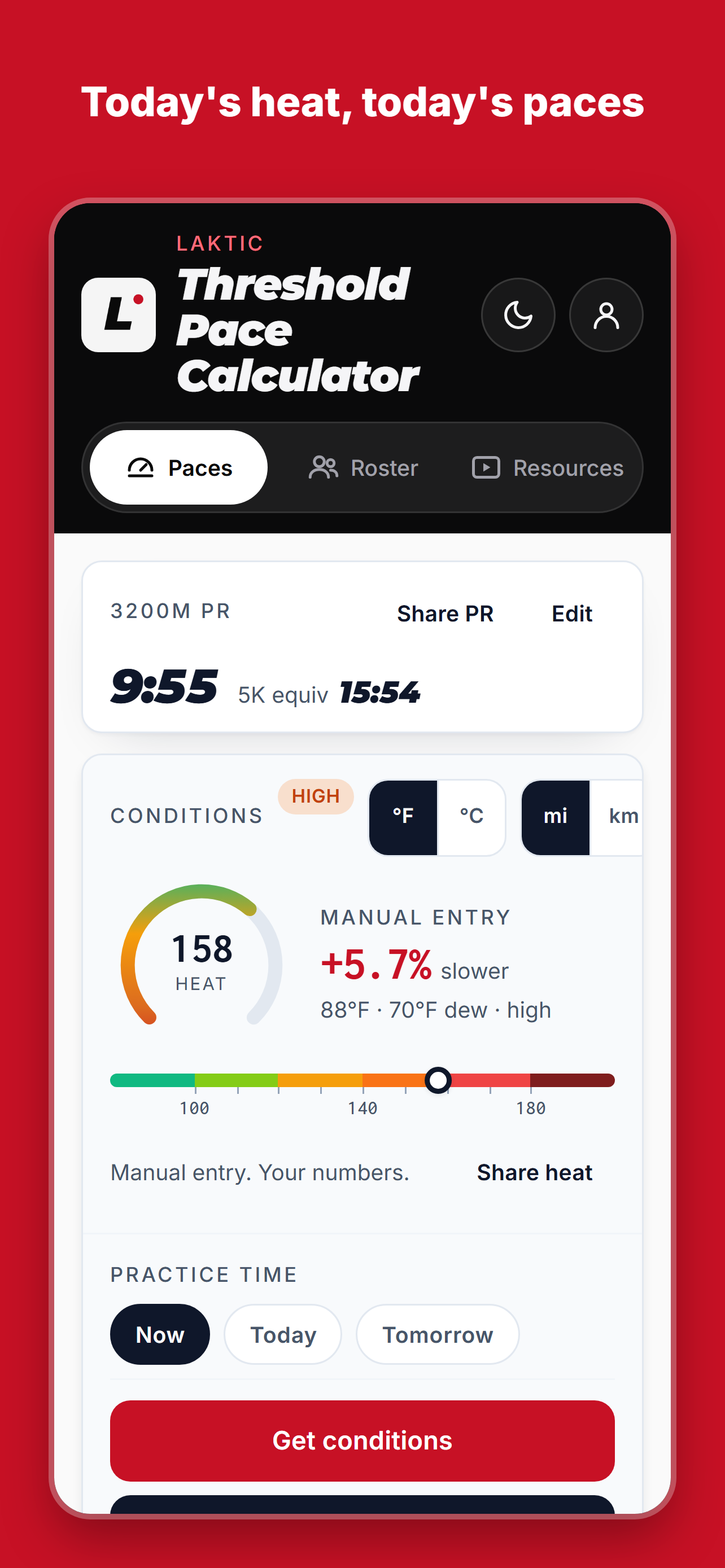
Enter a race PR. Get LT1, Sub-T and LT2 paces slowed for the temperature and dew point at your track. Coaches: your whole roster on one board.
How it works
Three inputs. Today's paces.
Enter a race PR
Track: 1500m, 1600m, mile, 3000m, 3200m or 5000m, plus training age for mile-type PRs. Road: 5 mile, 10K, half and marathon. The engine converts it to a 5K equivalent.
Get the conditions
One tap pulls temperature and dew point for your track from Open-Meteo, or type them in yourself.
Read the paces
LT1, Sub-T and LT2 by rep length, plus Easy, Long Run, Steady and, for road PRs, half and marathon race pace. Per mile or per km, each slowed by the day's heat score.
Features
Built for the track in August.
Heat score
Temperature plus dew point. Under 100 nothing changes; from 100 to 180 the paces slow by a rising percentage.
Zones and rep lengths
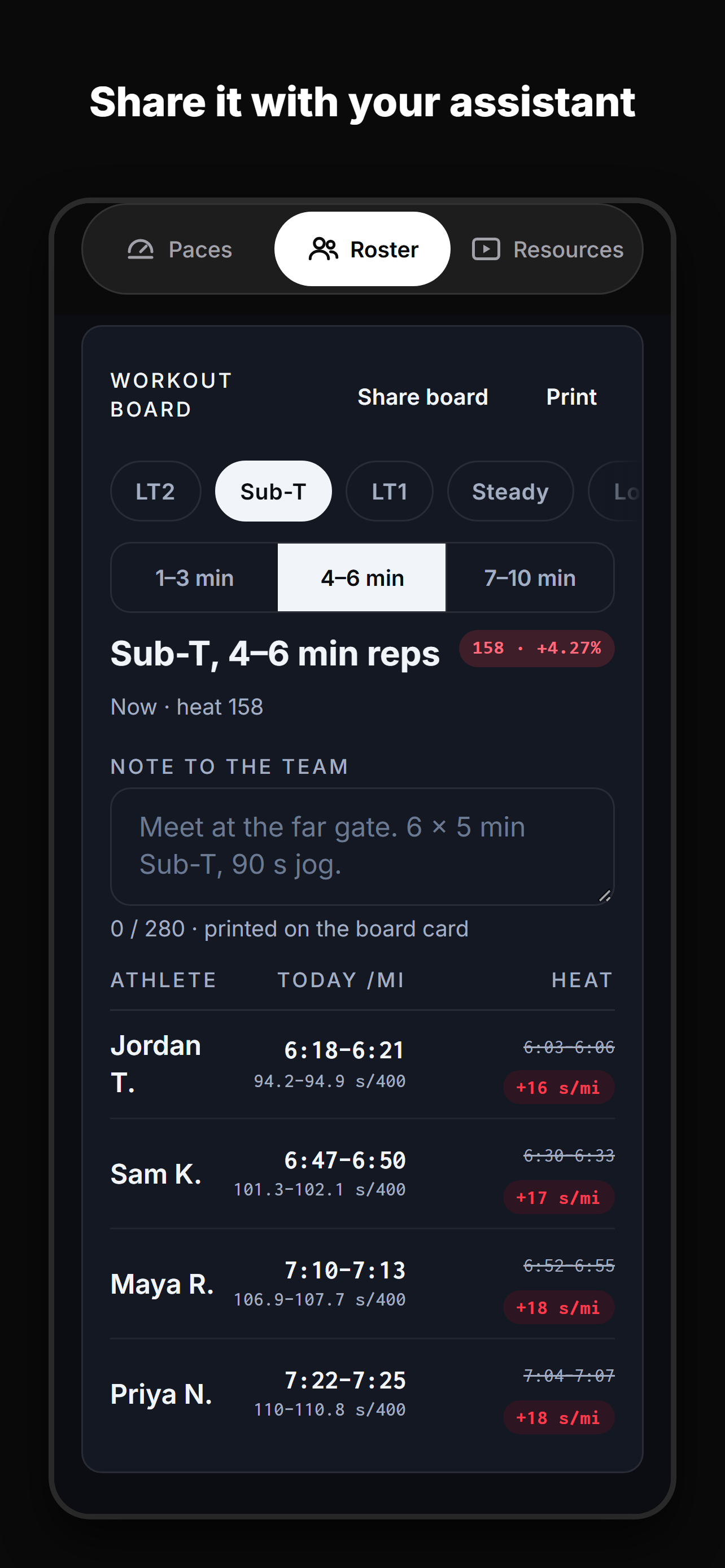
Every zone has 1–3, 4–6 and 7–10 minute rep paces. Short reps carry less of the heat penalty than long ones.
Roster and workout board
Add the team once. Pick a zone and rep length and every athlete's pace is on one board, ready to print.
Share cards
One tap turns the board, today's paces, the heat score or a new PR into an image for the team chat or your story. Base pace, today's pace and what the heat cost, side by side.
Session done
After the workout, log the reps you ran. Each one lands as a hit, hot or cold against the band the app gave you, then share the card.
Sync across devices
Works without an account. Sign in only if you want the roster on your phone and laptop at the same time. Share links carry the roster too, and dark mode keeps the board readable at dusk.
Why I built it
A coach's note
I've been in this sport for over a decade as a pro and as a coach, and the same problem kept showing up at practice: how do we know where to train today?
Most running calculators overestimate aerobic fitness, because they work off personal bests from track races, the shorter distances, and they never adjust for how long the reps are or what the weather is doing. So a 1600m kid gets a threshold pace he can't hold, and a 90-degree afternoon gets the same paces as a cool morning. This app is my fix for what I was seeing every day as an athlete and a coach. One PR in, today's paces out, adjusted for the distance it came from, the rep length, and the heat.
So this calculator does a few things the others don't. It builds paces for the full band, not just LT2. It corrects for mile and 1600m PRs, which high school coaches usually have and which predict threshold far too fast; a training-age buffer scales them down for an aerobic system that is still developing. It adjusts for rep length, because threshold pace for one-minute reps is not threshold pace for ten-minute reps; the accumulation of time matters. And it handles summer in the Northeast: an 80-degree day with high humidity turns a threshold session into something closer to VO2 work. The heat model reads live weather and dials the paces back so you don't have to guess.
It comes from the research, from field testing, and from feedback from athletes and coaches. The goal is simple: train smarter, adjust for distance, heat, and rep length, and always stay on the safe side.
Travis Mahoney, Laktic
Pace engine: Track and Road Performance
I also coach a small group of athletes one to one, high school to a 2:14 marathon, and write the Laktic Newsletter, a monthly letter on running research, training theory, and Laktic news.
The zones
LT1, Sub-T, LT2, and where today's workout sits
The app turns one race PR into a 5K equivalent, then places every zone relative to it. Here is what each one means and how to use it.
Easy and Long run
Conversational. Below LT1.
Most of the week lives here. Easy runs and long runs sit under the aerobic threshold, so recovery keeps up with the volume. In heat these slow the least in percentage terms, but they still slow.
LT1
Aerobic threshold. Comfortably hard, full sentences.
The first point where lactate rises above resting levels. Steady work here builds the aerobic engine with a low cost. Long reps and steady runs are the natural fit.
Sub-T
Just under LT2. Controlled and repeatable.
Bakken's golden zone. Most of your threshold volume belongs here: fast enough to drive adaptation, slow enough to repeat two or three times a week without digging a hole. If you run one threshold system, run this one.
LT2
Lactate threshold. Roughly one-hour race effort.
The fastest pace lactate stays stable at. Valuable in small doses, easy to overshoot, and the zone most calculators aim for exclusively. Use it for shorter reps and specific race prep, not as the daily default.
Rep length and heat
Same zone, different pace.
One-minute reps at threshold are faster than ten-minute reps at threshold; the app shows 1–3, 4–6 and 7–10 minute ranges for every zone. Then today's heat score slows each one. Pick the zone, pick the rep length, and the board does the rest.
Guidance, not a lab test. Use effort and lactate readings to confirm, and use judgment on hot days.
Coming
Laktic Pro × PackRabbit
Accurate paces for every athlete. Less friction for the coach.
This is not a stack of AI tools. It does one job: get the right training to the right athlete, faster and with fewer mistakes. Every athlete has a profile with personal bests, measured or estimated thresholds, zones and race paces. The coach writes a session once, “6 x 5 minutes at Sub-T”, and each athlete receives their own numbers. Groups make a team of forty as quick as one athlete. Sessions reach each athlete’s phone with the day’s heat already applied, and what they ran comes back to the coach.
Built with PackRabbit, a coaching platform, as one app. PackRabbit brings the team side: roster, training groups, assistant coaches, a workout builder, saved workouts and publishing to each athlete. Laktic brings the engine: zones and race paces from each athlete’s own profile, with measured lactate thresholds taking priority over estimates, adjusted for the heat where they train. High school programs, clubs and training groups first.
- Athlete profiles: PBs, thresholds, zones, race paces
- Write once, every athlete gets their paces
- Groups for teams of any size
- Delivered to the athlete’s phone
- Day-of heat adjustment
- Fewer prescription errors